宇宙膨張の証明
膨張していると言うのは、膨張していくエネルギーが重力に勝っている状態!
では膨張は無限に続くのか、はたまた膨張が止まり、縮み始めるのか?
それを解く鍵がブラックマターと呼ばれる物質、見えない物質なのでそう呼ばれているわけですが、その量がかなり多いとなると宇宙は広がり続け、平坦になるそうです。
はて、その景色は・・・?!
参照
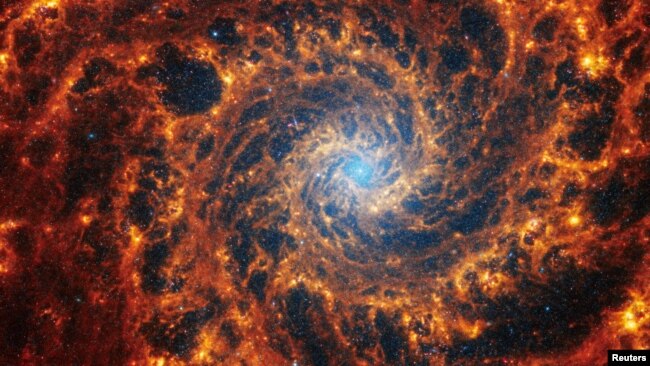
Data collected by the James Webb Space Telescope has confirmed earlier information suggesting the universe is expanding at a faster rate than scientists had expected.
The new finding is based on measurements collected by the Webb over the past two years. The telescope is operated by the American space agency NASA.
Researchers say the new readings show that our universe is growing faster today than it did in the period after it first formed billions of years ago. The data suggests the distances between nearby stars and galaxies are increasing. This confirms earlier studies based on data collected by other telescopes.
The finding that today’s universe is expanding faster than expected was first made in the 1990s by data gathered by NASA’s Hubble Space Telescope. In 1998, data examinations led a group of scientists to first conclude that our universe is expanding at an ever-increasing rate.
That finding was based on studies of huge explosive events called supernovas. NASA describes a supernova as an “extremely bright, super-powerful explosion of a star.” A supernova takes place at the end of a star’s life.
The 1990s research on supernovas and the universe’s continued expansion resulted in three scientists winning the 2011 Nobel Prize in Physics. One of the winners – Adam Riess of Johns Hopkins University in Maryland – was the lead writer of a study on the new data collected by the Webb telescope.
The study notes the idea of the universe expanding at an unexpected rate – and the mysterious reasons behind the growth – has long been known as Hubble Tension. The Nobel winners were awarded the prize in part for showing evidence that Hubble Tension may be caused by forces they describe as “dark energy.”
NASA says astronomers believe dark energy makes up about 68 percent of the universe, while dark matter makes up around 27 percent. But beyond that, very little is known about these two “dark” elements.
Riess – a professor of physics and astronomy – wrote about the new data produced by the Webb telescope observations. He said in a statement, "The discrepancy between the observed expansion rate of the universe and the predictions of the standard model suggests that our understanding of the universe may be incomplete."
Riess noted that data from both the Webb and Hubble instruments had confirmed the earlier findings linked to the Hubble Tension problem. He said the ongoing mysteries of how dark energy might affect faster universe expansion presents a major “challenge” for scientists. However, the new data also provides new possibilities “to learn more about our universe.”
The researchers used three different methods to measure a specific value – the distances from Earth to galaxies where a kind of pulsating star called a Cepheid had been identified.
The universe's expansion rate is measured in kilometers per second as megaparsecs, a distance equal to 3.26 million light-years. A light-year is the distance light travels in a year, about 9.5 trillion kilometers.
The researchers said the Webb’s observations appear to rule out the idea that the earlier Hubble data might have returned false information because of possible instrument errors. The team’s findings recently appeared in a study in the publication The Astrophysical Journal.
Siyang Li is a doctoral student in astronomy at Johns Hopkins who was a co-writer of the study. He told Reuters news agency the Webb results could mean “there may be a need to revise our model of the universe.” However, Li added that such a revision would be very difficult to make currently with existing data.
Li also noted a great improvement in the Webb data compared to the older Hubble information. "The Webb data is like looking at the universe in high-definition for the first time and really improves the signal-to-noise of the measurements,” he said.
The researchers suggested more work is needed to possibly unlock the Hubble Tension mystery. Riess said more data observations will be necessary to learn about what forces are continuing to drive expansion of the universe. And the team will next try to capture more detailed data on the rate of expansion, as well as seek to establish timelines for the growth.
Words in This Story
discrepancy – n. a difference between two things that should be the same
challenge – n. something difficult that tests one’s ability or determination
pulsate – v. to beat or move with a strong, regular rhythm
revise – v. to change something so that it is more correct
high-definition – adj. a system for showing very clear pictures on a television or computer screen
NASAのジェイムズ・ウェッブ、宇宙の継続的な膨張を確認(和訳)
ジェイムズ・ウェッブ宇宙望遠鏡が収集したデータは、科学者の予想よりも速い速度で宇宙が膨張していることを示唆する以前の情報を確認しました。
この新たな発見は、ウェッブ望遠鏡が過去2年間に収集した測定結果に基づいています。この望遠鏡はアメリカの宇宙機関NASAによって運営されています。
研究者らは、この新しい測定結果は、我々の宇宙が数十億年前に初めて形成された後の時代よりも、現在の方がより速く成長していることを示しているといいます。このデータは、近くの星や銀河間の距離が伸びていることを示唆しています。これは、他の望遠鏡で収集されたデータに基づく以前の研究を裏付けるものです。
今日の宇宙が予想よりも速く膨張しているというこの発見は、NASAのハッブル宇宙望遠鏡が収集したデータによって1990年代に初めてなされました。1998年、データ調査によって科学者グループは初めて、我々の宇宙はますます勢いをましながらat ever-increasing rateで膨張していると結論づけました。
この発見は、超新星supernovasと呼ばれる巨大な爆発現象の研究に基づいています。NASAは超新星を”非常に明るく、超強力な星の爆発”と表現しています。超新星は星の一生の終わりに起こります。
超新星と宇宙の継続的な膨張に関する1990年代の研究により、3人の科学者が2011年のノーベル物理学賞を受賞しました。受賞者のひとり、メリーランド州にあるジョンズ・ホプキンス大学のアダム・リース氏は、ウェッブ望遠鏡が収集した新しいデータに関する研究の主執筆者です。
この研究では、宇宙が予想外の速度で膨張しているという考え方–そしてその膨張の背後にある謎めいた理由について–は、長い間ハッブル・テンション(ハップル緊張)として知られてきたと指摘しています。ノーベル賞受賞者たちは、ハッブル緊張が ”暗黒エネルギー ”と表現される力によって引き起こされている可能性があるという証拠を示したことで、賞を授与されました。
NASAによれば、天文学者は、暗黒エネルギーが宇宙の約68%を占め、暗黒物質が約27%を占めると考えています。しかし、それ以上にこの2つの ”暗黒 ”の要素についてはほとんどわかっていません。
リース氏– 物理学と天文学の教授– ウェッブ望遠鏡の観測によって得られた新しいデータについて書いています。彼は声明で、「観測された宇宙の膨張率と標準モデルの予測との不一致discrepancyは、我々の宇宙に対する理解が不完全である可能性を示唆している」と述べています。
リース氏は、ウェッブ望遠鏡とハッブル望遠鏡のデータから、ハッブル緊張問題に関連する以前の発見が確認されたと指摘しました。彼はダークエネルギーがより速い宇宙の高速膨張にどのような影響を与えるかという現在進行中の謎は、科学者にとって大きな”挑戦”であると話しています。しかし、この新しいデータは、”我々の宇宙をより深く知るための ”新たな可能性をも提供するものです。
研究者たちは、ある特定の値–ケフェイドと呼ばれる一種の脈動星pulsatingが確認された銀河までの地球からの距離 –を測定するために、3つの異なる方法を用いました。
宇宙の膨張速度はメガパーセクとして毎秒キロメートル単位で計測されます、その距離は326万光年に相当します。光年は光が1年間に進む距離で、約9兆5000億キロメートルです。
研究者たちは、ウェッブの観測は、以前のハッブル望遠鏡のデータが機器のエラーによって誤った情報を返した可能性を排除するものだと述べています。このチームの発見は、最近アストロフィジカル・ジャーナル誌に掲載されました。
ジョンズ・ホプキンス(大学)で天文学博士課程に在籍するシヤン・リー 氏は、この研究の共同執筆者です。彼はロイター通信に対し、ウェッブの結果は”我々の宇宙モデルを見直す必要があるかもしれない”ことを意味しているかもしれないと語っています。しかし、そのような修正は、現在のデータでは非常に困難であるとリー氏は付け加えています。
リー氏はまた、ウェッブのデータは古いハッブルの情報と比較して大きく改善されていると指摘しています。「ウェッブのデータは、初めて高い精密度(ハイビジョン)in high-definitionで宇宙を見たようなもので、測定のS/N(信号対雑音)が非常に向上しています」と彼は話します。
研究者たちは、ハッブル緊張の謎を解明するためには、さらなる研究が必要であることを示唆しました。リース氏は、宇宙の膨張を促進し続けている力が何であるかを知るためには、さらなるデータ観測が必要であると述べています。そして研究チームは次に、膨張の速度に関するより詳細なデータの取得を試みるとともに、膨張の時間軸の確立を目指す予定です。
